

Employer matching gifts are a big fundraising opportunity already sitting inside your donor base. Thousands of companies will match the donations their employees make to eligible nonprofits, often dollar for dollar.
NB: Note: This guide applies mainly to nonprofits in the US and Canada, where employer matching gift programs are most common. Outside these regions, the Double the Donation integration can still be enabled—reach out to Funraisin support to discuss how it could work for you.
Nonprofit budgets are under pressure from both ends right now.
On one side, donor databases across the US and Canada are shrinking. Fewer people are giving as a result of changing donor behavior, demographic shifts, tax law changes, and increased competition for attention. Inflation and the rising cost of living have also squeezed small-dollar donors who used to make up the bulk of many databases.
On the other side, demand for nonprofit services is climbing. As household budgets tighten, more people are turning to food banks and social service programs to get by, in some cases pushing usage up 30% or more.
That combination means nonprofits need to raise more, from a pool of donors that's getting harder to grow, which makes it more important than ever not to leave money on the table. Now is the time to maximize employer matching gifts.
Historically, leveraging employer matching gift opportunities has been a manual, time-consuming process for nonprofit teams. That means some teams are unable to pursue these gifts at all or only react to opportunities that present themselves.
The Double the Donation integration with Funraisin alleviates the burden, making it simple and straightforward for both your team and your donors to identify and apply for every eligible match, so you can raise more money without increasing your workload.
Keep reading to see how it works.
The opportunity: Matching gifts multiply donations without a second ask
Fundraising teams juggle big goals with limited time and budget. They need to be efficient and effective. Employers have the power to multiply an employee's donation, acting as a built in campaign enhancer without asking anyone to give more.
Even better, matching gifts have the power to change how donors behave. Research on workplace giving shows that:
84%
of donors are more likely to give if a match is offered
1 in 3
donors would give more if they knew a match was available
Mentioning matching gifts in appeals lifts:
71%
response rate
51%
average donation size
Donors love a match because it makes their donation go further. That gives your team a stronger story to tell every time you ask.
An estimated $4 to 7 billion in matching funds is available every year
Over 26 million people work for companies that offer matching gifts. Industry estimates put the available corporate funding at $4 to $7 billion each year, with much of it is still up for grabs.
$4–7B
Estimated corporate matching funds available every year, much of it still unclaimed.
26M+
employees work for companies with matching programs
78%
of donors don't know if their employer offers a match
Awareness is the key. Around 78% of donors are unaware their employer runs a matching program. Every time you mention matching gifts, you help more supporters discover funding their employer has already set aside for missions like yours.
What stops nonprofits from making the most of employer matched giving?
Pursuing matching gifts has historically been a lot of work for nonprofits.
Company criteria vary, continually change, and span thousands of employers, so small teams either skip matching gifts altogether or chase them reactively, one match at a time, instead of proactively surfacing every eligible gift.
That's where Double the Donation comes in. They maintain a searchable, constantly updated database of employer matching programs, and Funraisin's integration puts that lookup right on your donation form, so your team doesn't have to track the rules to make the opportunity easy to find and easy to act on.
For example, a nonprofit might know Acme Corporation matches gifts and proactively reach out to Acme Corporation participants —but when Acme Corporation quietly increases the match from a 1:1 to a 2:1 match or changes the submission deadline, most teams are unaware and might communicate out of date information. This is exactly the kind of change Double the Donation's database catches and communicates automatically.
Here are three steps to make the most of the employer matched giving opportunities:
01.
Get a lay of the land
02.
Make the match visible
03.
Close the loop
STEP 1 OF 3
Step one: Get a lay of the land
Corporate matching programs don't follow one fixed rulebook—every company sets its own criteria, and those criteria may shift over time.
With thousands of employers each running their own version, no one on your team is ever going to fully "know the rules."
What you can do is get familiar with the common patterns, so matching gifts feel like a predictable funding source instead of a black box.
Staying current on every company's specifics is exactly what Double the Donation's database is built to handle, so your team can save on time and admin costs.
Most nonprofits are eligible
Nearly two-thirds of employers match gifts to most 501(c)(3) nonprofits, according to America’s Charities. Community programs, health organizations, schools, and environmental groups are almost always included. Companies set their own rules around political groups and houses of worship, so a quick eligibility check is particularly useful for these types of organizations.
Employers also decide which staff can take part. Full-time employees are the baseline, but many companies extend the benefit to part-time staff, retirees, and even spouses.
Match ratios start at 1:1 and can climb higher
A dollar-for-dollar match is the most common setup. Some companies go further and match at 2:1 or 3:1, depending on their giving budget.
Minimum donations are usually $25 or less. Annual caps per employee usually range from $1,000 to $25,000.
Deadlines vary by company, so tracking them pays off
Each company sets its own submission window. Some allow a set number of months after the donation date, others close requests at the end of the calendar year. A simple deadline tracker is a necessity.
What to do next:
- Build a cheat sheet of the five most common matching gift policies in your donor community.
- Train your donor support team to answer basic questions about eligibility and timelines.
- Add a targeted outreach push to your calendar three weeks before year-end corporate deadlines.
Key takeaway: getting familiar with corporate giving eligibilty criteria will help your team guide donors through the request process and bring in more matched funding.
STEP 2 OF 3
Step two: Make the match visible
Weaving matching gift messages into your regular communications keeps the opportunity top of mind. When a supporter decides to give, you want them to already connect their donation with a possible match.
Integrate employer matching into your donation flow
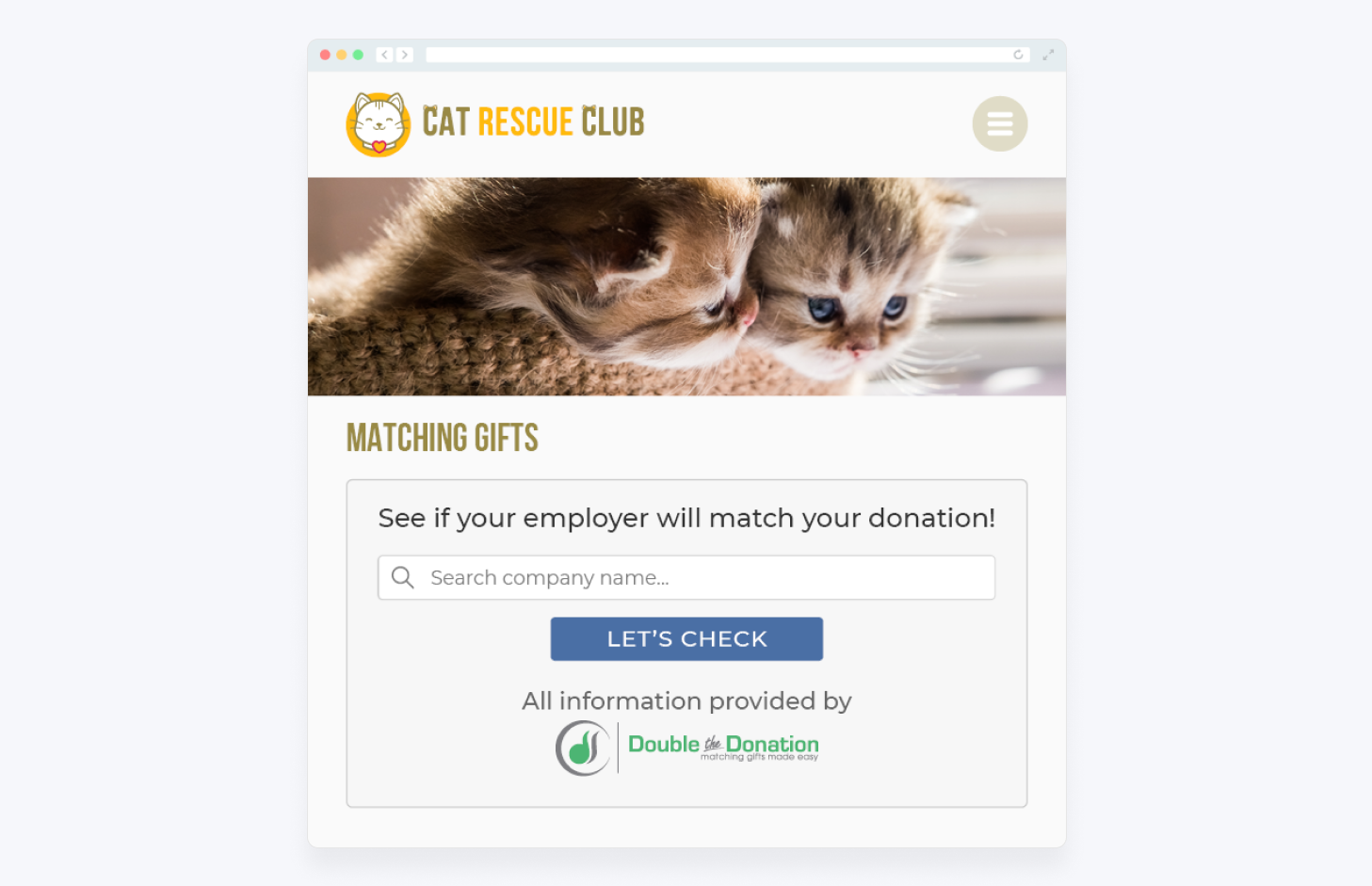
The best donation forms let donors check their match eligibility as they give by embedding matching gift search functionality that lets donors check their eligibility in real time.
A short line above the field works well: "Does your employer match gifts? Enter your company name and we'll check for you."
Follow up while the gift is fresh
Donors are most likely to submit a match request right after giving. A triggered thank-you email that links straight to their company's submission portal using a Personalized URL helps them act while the moment is still warm.
Spread the message across every channel
Matching gifts can show up anywhere your supporters do. A few ideas:
- Build a matching gift page on your website that reminds your donors how it works, and what impact it can have for the cause.
- Share social posts and short videos that explain how matching works.
- Mention matching in your regular fundraising appeals.
- Add an insert to your direct mail campaigns.
- Write a two-sentence matching blurb for staff email signatures.
Pick the channels that suit your team. The goal is always to keep the match opportunity visible wherever supporters meet you.
What you can do next:
- Review your donation page and check how visible matching gifts are before the payment button.
- Create a dedicated matching gift page if you don't have one yet.
- Schedule social proof, for example, a social post or email featuring a real donor whose employer matched their gift.
Key takeaway: timely, well-placed reminders help match-eligible donations move from first pledge to paid corporate match.
STEP 3 OF 3
Step three: Close the loop with a double thank you
A thoughtful thank-you plan recognizes both the original gift and the extra step the donor took to secure corporate funds. Genuine gratitude makes supporters feel like true partners in your mission.
Celebrate the gift + match submission
Start the moment a supporter requests a match. An "I've submitted my match" button in your reminder emails makes it easy for donors to tell you they've acted.
When they do, send a prompt thank-you. This keeps the momentum going while the match works its way through the company's approval process.
Close the loop when the funds arrive
The final step comes when the company pays out the match. Send a personal follow-up to the original donor and celebrate the win together. Show them the full impact of their doubled gift.
Donors who see their effort turn into real corporate funding feel a strong sense of achievement, and are more likely to request a match for future contributions.
What you can do next:
- Check your automated receipts for clear next steps on employer matching.
- Set up an internal alert for when a donor marks a match as submitted.
- Draft a celebratory email template for the day the matching check lands.
Key takeaway: thanking donors at both stages builds loyalty and lifts recurring donor retention.
Final takeaways and next steps
Employer matching gifts are a high-return revenue stream already sitting in your donor base, and claiming it starts small. Get familiar with the common patterns in the rules your donors' employers set. From there, keep the match visible at the moment of giving and close the loop with a proper thank-you at both ends.
Automation carries most of the load. The Double the Donation and Funraisin integration checks employer eligibility right on your donation form, so your team can spend its time on the thank-yous rather than the admin.
Frequently asked questions about matching gifts
What is an employer matching gift?
An employer matching gift is a donation a company makes to augment an employee's gift to an eligible nonprofit. Most companies match dollar for dollar, and the employee submits a short request form to trigger the match.
How do donors find out if their employer matches gifts?
Most donors check through a matching gift search tool on a nonprofit's donation page or website. Tools like Double the Donation hold company policies, forms, and submission links in one searchable database.
How much do companies match?
A 1:1 ratio is the most common, and some companies match at 2:1 or 3:1. Minimum donations are usually $25 or less, and annual caps per employee usually range from $1,000 to $25,000.
Do employer matching gift requests expire?
Yes. Each company sets its own deadline, often a set number of months after the donation or the end of the calendar year. Prompt reminders after each gift help donors submit in time.
Turn on matching gifts in your next campaign
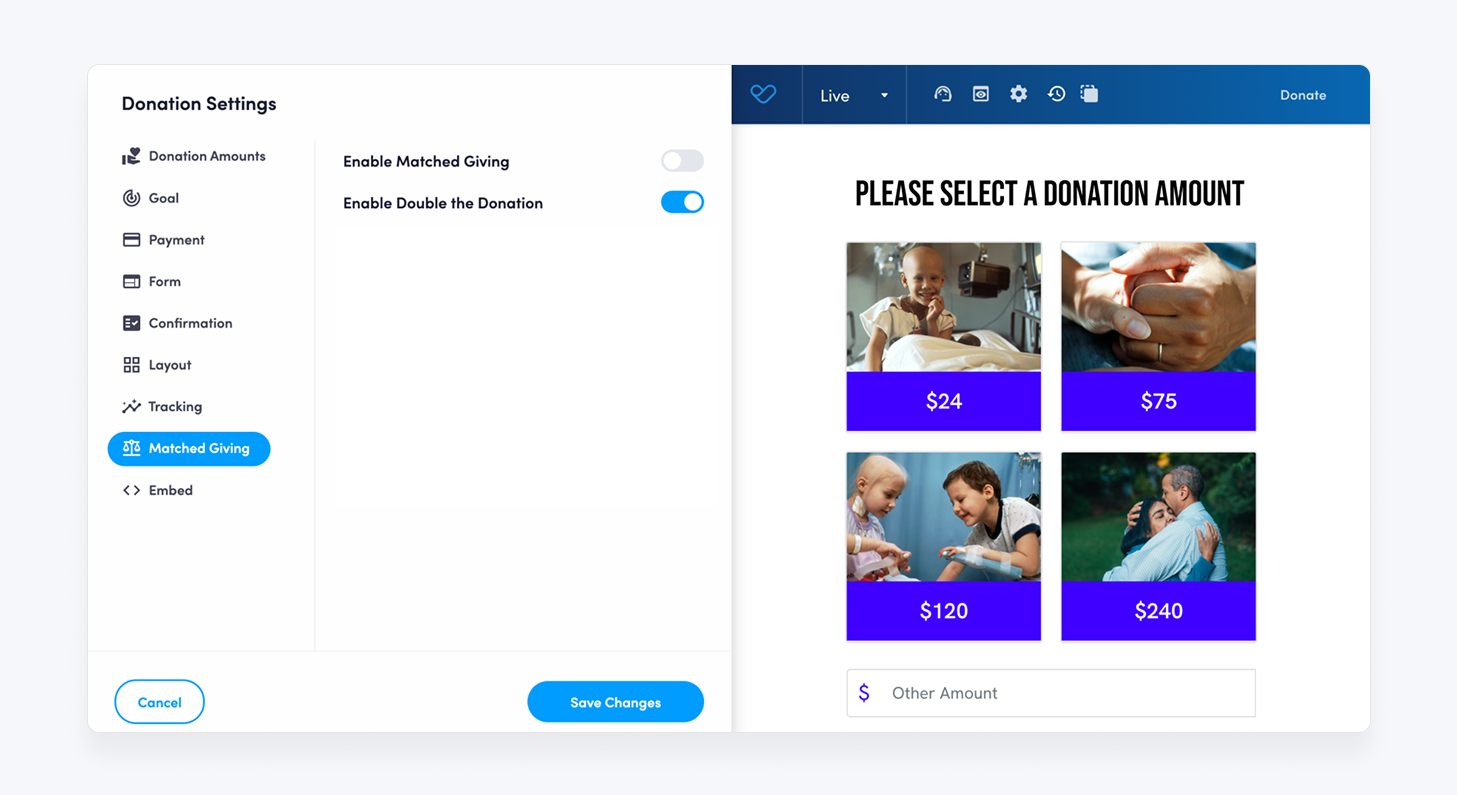
The Double the Donation integration is built into Funraisin. Once connected, donors can check their employer's matching program right on your donation form, and reminders go out automatically.
Setup takes just minutes!
