



The Australian and New Zealand peer-to-peer sector had a genuinely good year in 2025.
Revenue reached almost $227 million—up 6% on the year before. Twenty-five of the top 30 events grew. Physical events had their strongest year since before COVID. Virtual events broke out of the flat revenue pattern they’d been stuck in for four years.
That’s worth sitting with for a moment. After a couple of challenging years, the sector showed very positive growth.
The more interesting question is: what actually drove it—and what does that tell us about 2026?
Five years of data reveals where real growth comes from
When you look at the full five-year picture, the events that have grown consistently share something in common—and it’s not budget or cause area.
Virtual event revenue across the sector has grown 10% over five years, against 25% inflation. The events sitting well above that average are the ones that have gotten more precise: clearer on their audience, sharper on their cause message, more deliberate about who they re-engage and how.
That’s the pattern 2025 showed, and it’s a guide to where growth will come from in 2026.
2025 recovered because conditions improved—and the sector made the most of them
Peer-to-peer fundraising performance tracks closely with economic mood, and 2025 had genuine tailwinds.
As interest rates began to fall and consumer confidence edged back up, P2P performance followed:
- Meta’s cost to reach 1,000 people dropped 10% year on year
- Cost per click fell 16%
- Click-through rates rose 19%
More people were receptive, and reaching them cost less. The sector responded well—and the results showed it.
The events growing fastest aren’t relying on volume—they’re getting more from the participants they already have
One figure from the 2025 data stands out: 96% of all P2P event revenue came from repeating events.
That’s not a constraint—it’s a signal. The strongest growth opportunity in this market is the audience you’ve already built. The relationship is there. The trust is there. The opportunity is how you use it.
The top 30 events that grew fastest in 2025 weren’t the ones that recruited most aggressively. They were the ones that re-engaged most effectively—great segmentation, sharp cause messaging, personalised participant journeys.
That’s a playbook anyone can run.
Digital acquisition is getting more competitive—which makes on-platform performance more valuable
Media costs are moving. In the first three months of 2026:
- Meta’s CPM has increased by 25% compared to the same period last year
- Cost per acquisition is up 23%
That’s not a reason to pull back—it’s a reason to empower every participant to raise as much as possible.
That’s where platform performance—your registration flow, your coaching journey, your giving handles—directly affects your return.
The takeaway: Three things to focus on in 2026
The full picture from 2025 is genuinely encouraging. The sector grew, the top events performed strongly, and the patterns behind that growth are replicable. Here's what we recommend focusing on for 2026:
1. Get specific with your cause message.
The campaigns that grew fastest in 2025 committed to one clear, emotionally resonant cause message—not a range of outcomes. When fundraisers know exactly what they’re raising money for, they ask with more confidence. That specificity compounds across every touchpoint.
2. Treat re-engagement as your primary growth lever.
With acquisition costs rising, the return on an existing participant has never been higher. Segment your lapsed and returning audiences deliberately, and build journeys that reflect what they already know about you.
3. Put more behind your top 20%.
Across the top 30 events, the top 20% of fundraisers raise 62% of all funds—and that barely shifts year on year. These are your highest-leverage relationships. More personal attention, better timing, more specific support—the return is disproportionate.
All content in this blog is drawn from insights shared in the webinar Top 30 Peer-to-Peer Events Australia and New Zealand, recorded on March 31, 2026.
Want a deeper dive into the top 30 P2P events?
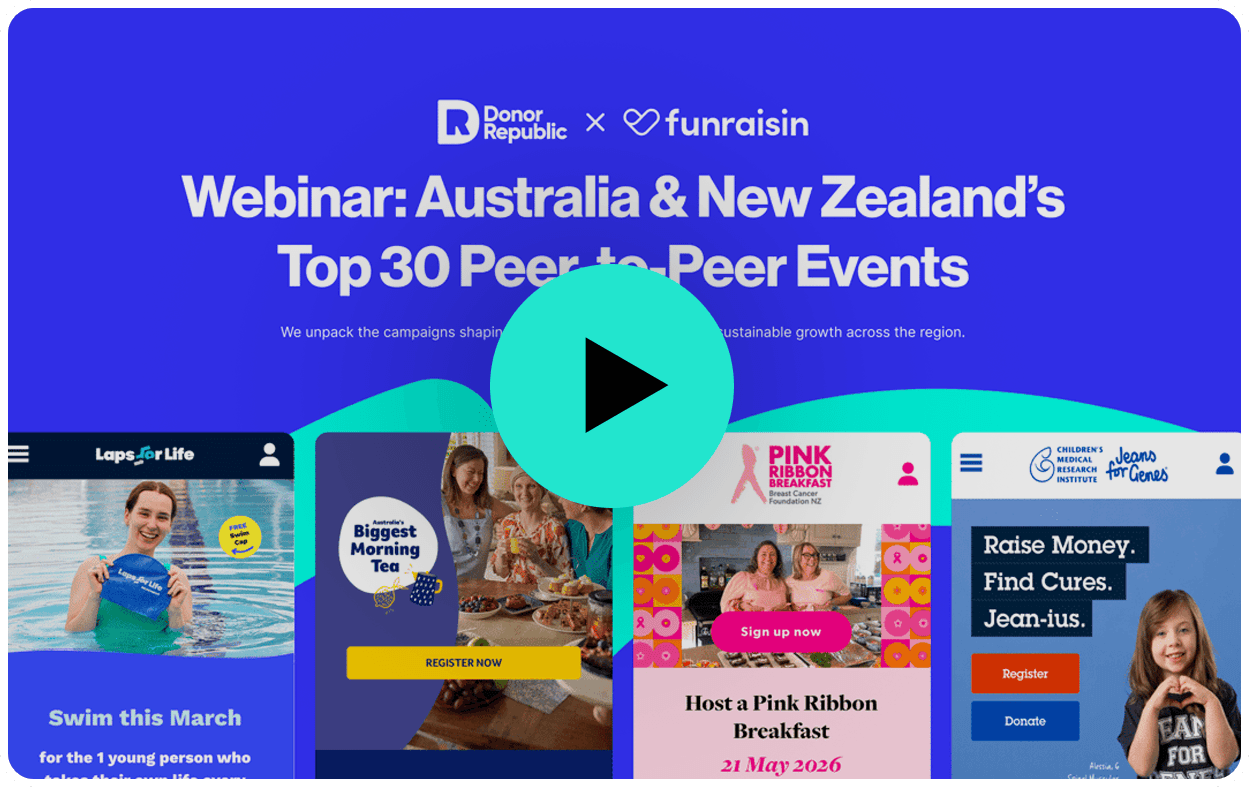
To see the full data behind these findings—including the complete Top 30 results, digital marketing benchmarks,
and activation insights, watch the webinar replay below:
New to Funraisin?
Want to make sure your platform is set up to support better retention, segmentation, and participant experience?
Already using Funraisin?
Want to talk through what this means for your 2026 strategy? The Donor Republic team would love to hear from you.
