




By mid-August 2026, Jeans for Genes had already raised more than $600k above its best-ever full year, with the total now above $3.7 million. The campaign wasn't close to finished: two of the campaign's five events, 100 Skips a Day and Ks for Kids, were still running, with donations continuing to come in through to the end of the year.
From completed registrations (up 35%) to active fundraisers (up 45%) and a Double Donation Day that outraised its own previous record by 52%, the growth wasn't a one-off spike. It showed up everywhere.
We sat down with Greg Noel-Butterworth (National Campaign Manager, Jeans for Genes) to unpack what actually changed.
Keep reading to find out how they did it.
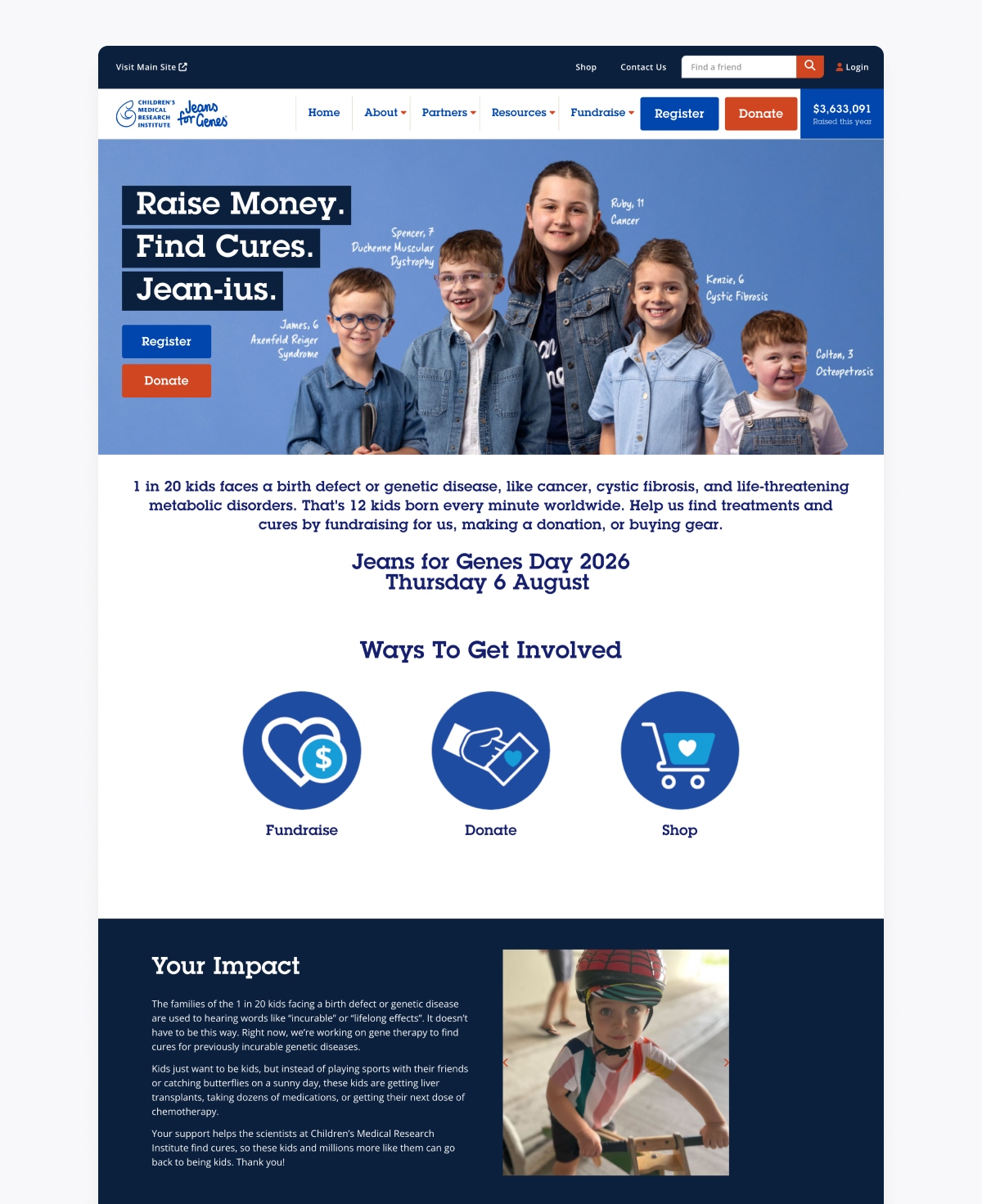
About the campaign: Jeans for Genes
Jeans for Genes Day is one of Australia's longest-running children's charity campaigns, raising funds each August for the Children's Medical Research Institute (CMRI), which researches treatments and cures for the 1 in 20 kids who face a birth defect or genetic disease, including cancer and cystic fibrosis.
Supporters wear jeans, host bake sales, skip, walk, or set their own challenge, with the funds raised helping researchers at CMRI bring cures closer through work spanning next-generation DNA sequencing to gene therapies described as the “medicine of the future."
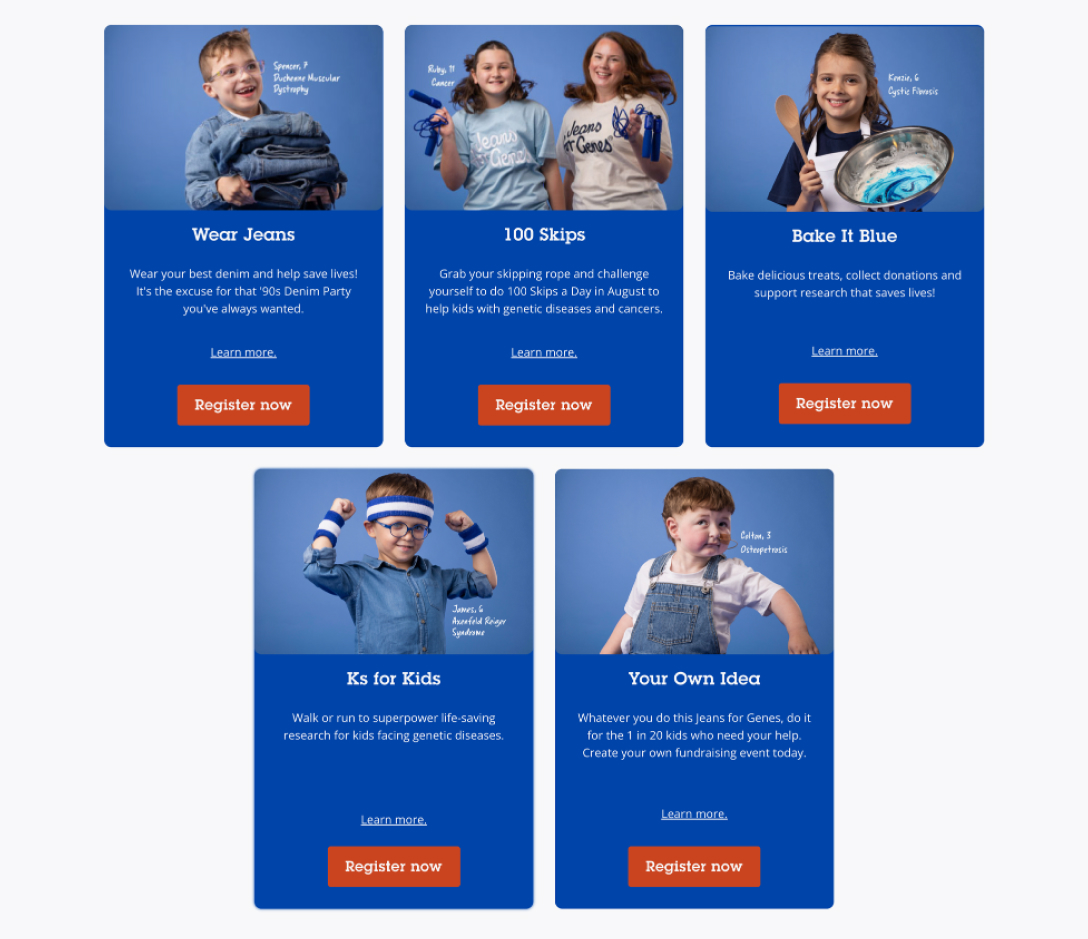
The campaign now runs as five concurrent peer-to-peer events across the month of August: Wear Your Jeans, Bake it Blue, 100 Skips a Day, Ks for Kids, and Your Own Idea, plus the campaign's single biggest moment, Double Donation Day.
This year alone saw 11k+ completed registrations, 4.2k+ active fundraisers, and upwards of $3.7 million raised, and climbing.
The challenge: Evolving beyond a declining merchandise-on-consignment model
For several years, Jeans for Genes had been in decline as its traditional merchandise-on-consignment model struggled to keep pace with modern peer-to-peer fundraising. The pandemic forced the question of what came next.

A merchandise-consignment model had quietly plateaued fundraising to under $1 million a year.
For years, the campaign worked by sending fundraisers physical merchandise—pens, wristbands, yo-yo's—and banking whatever they sold. It had once been a reliable model, but by this point, income had plateaued to around $900,000 - $1 million for several years, with limited opportunity for future growth.

The pandemic removed the ability to fundraise in person, right when the campaign needed a new mechanic.
With fundraisers unable to host events or gather supporters, the campaign needed an online alternative that could keep people engaged and giving without requiring anyone to leave the house.

Running five concurrent peer-to-peer events risked overwhelming a lean team.
As the campaign diversified into more events, the team needed a way to manage five simultaneous fundraising events without five times the manual work.

A one-size-fits-all donor page missed the opportunity to recognise returning supporters.
Every donor, whether giving for the first time or the fifth, saw the same generic ask, missing an opportunity to recognize loyal givers and tailor the amount to what they'd given before.

The campaign had been declining for several years and the traditional merchandise-on-consignment model had reached its limits. COVID forced us to accelerate the shift to digital, and that gave us an opportunity to completely rethink how Jeans for Genes could grow.

Greg Noel-Butterworth,
National Campaign Manager, Jeans for Genes
The solution: Turning a pandemic-forced pivot into a five-event portfolio built on timing and personalization
Rather than treating the digital shift as a one-time fix, CMRI used it as the foundation for a campaign that keeps getting more precise about who's giving, when, and why.
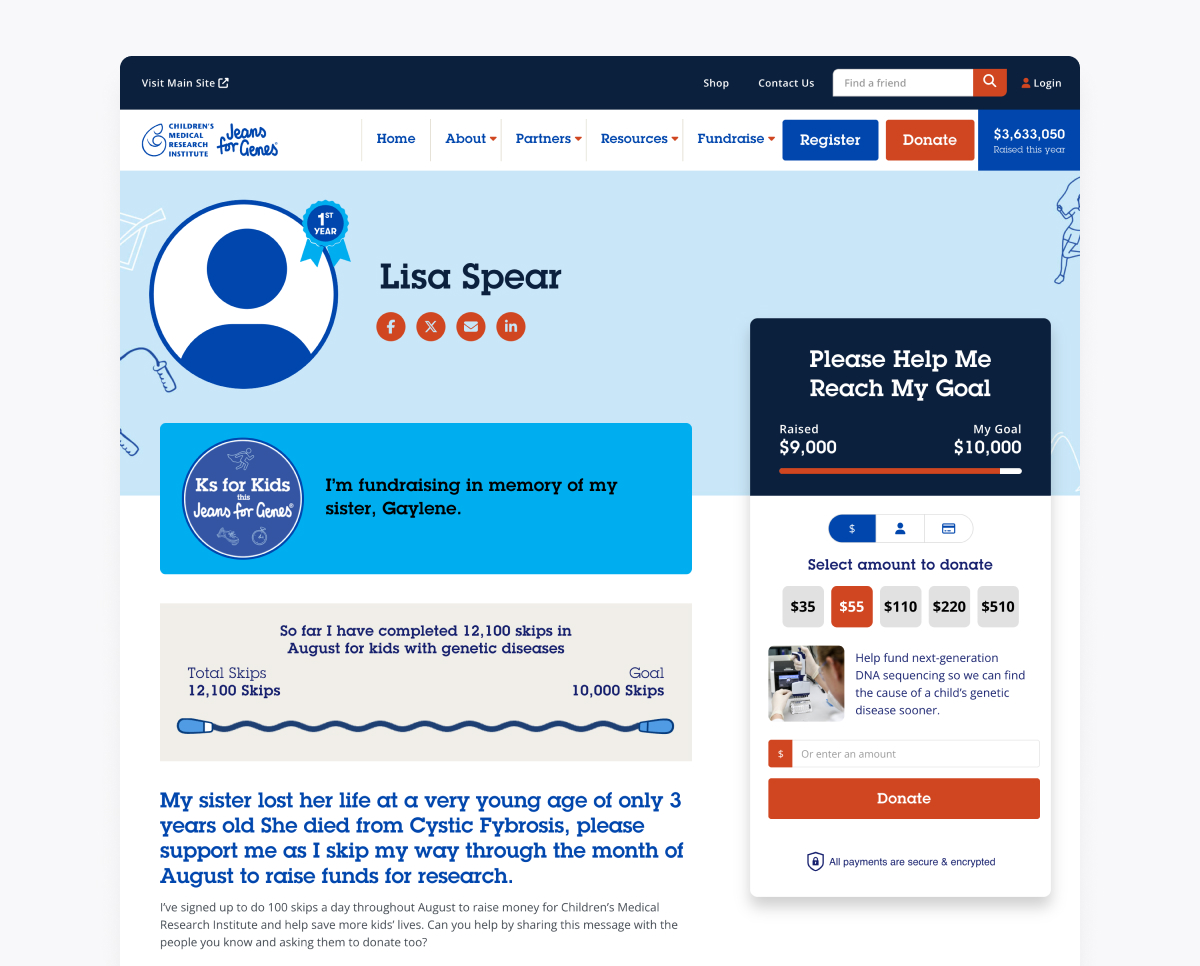
100 Skips a Day: proof that testing small before going all in pays off.
As a Facebook fundraiser, 100 Skips a Day plateaued at around $300,000 a year for several years running. Last year, CMRI moved it onto Funraisin for the first time and tested it as a mini peer-to-peer event — it hit $420,000, a record at the time. This year, developed into a full peer-to-peer event with its own dashboards, it's already raised $700,000 and is tracking toward $750k+, more than double what it raised as a Facebook fundraiser. It's a small case study in its own right for CMRI's broader philosophy: prove a concept small, then commit.
A 2024 mobile-first rebuild of every dashboard and fundraising page.
Working directly with Funraisin's design team, CMRI rebuilt every dashboard and fundraising page across the five events, optimising for mobile and addressing what Greg identified as the campaign’s biggest opportunity: improving the user experience. Fundraisers who experienced the improved UX returned in 2025 and again in 2026, with retention rates increasing significantly year on year.
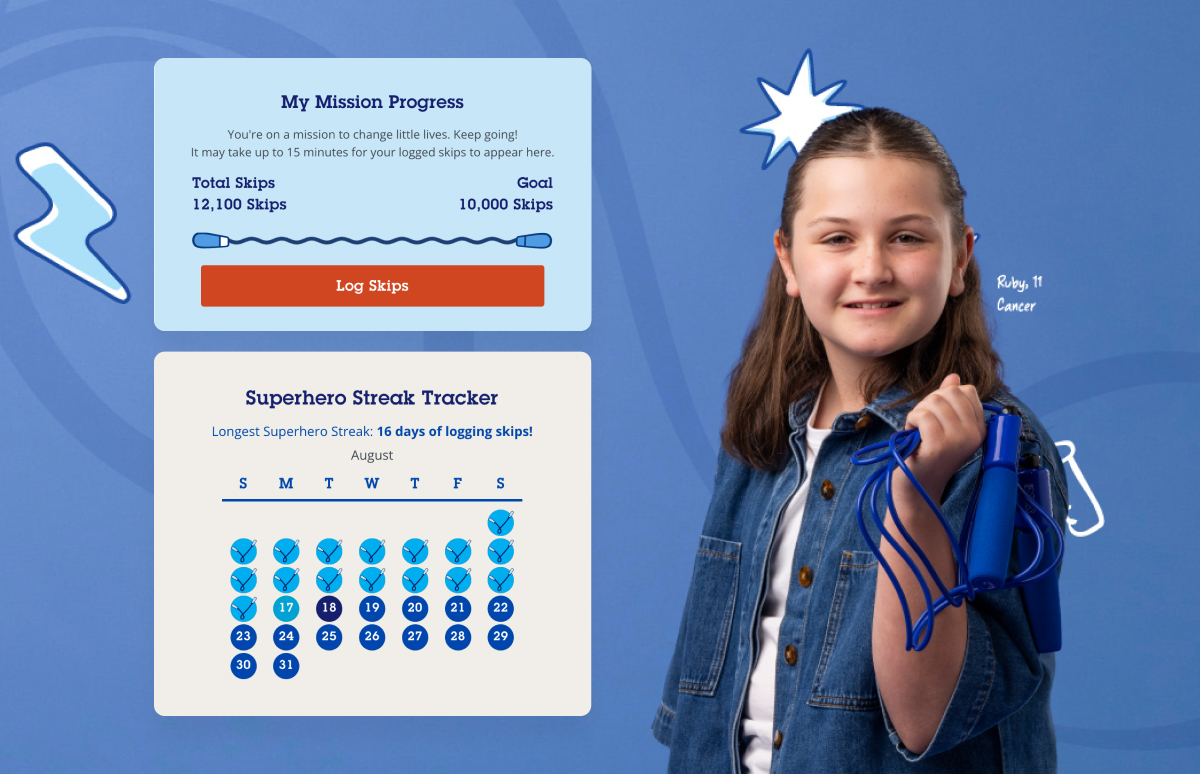
A Duolingo-inspired streak widget built to lock in engagement by day three.
On the 100 Skips a Day and Ks for Kids dashboards, a streak calendar tracks consecutive days of participation, paired with campaign comms that reward a three-day streak with a discount to CMRI's online store. The logic: fundraisers who hit three days are far more likely to stay engaged for the rest of the campaign.
An interactive lab tour connecting fundraising to real children and real labs.
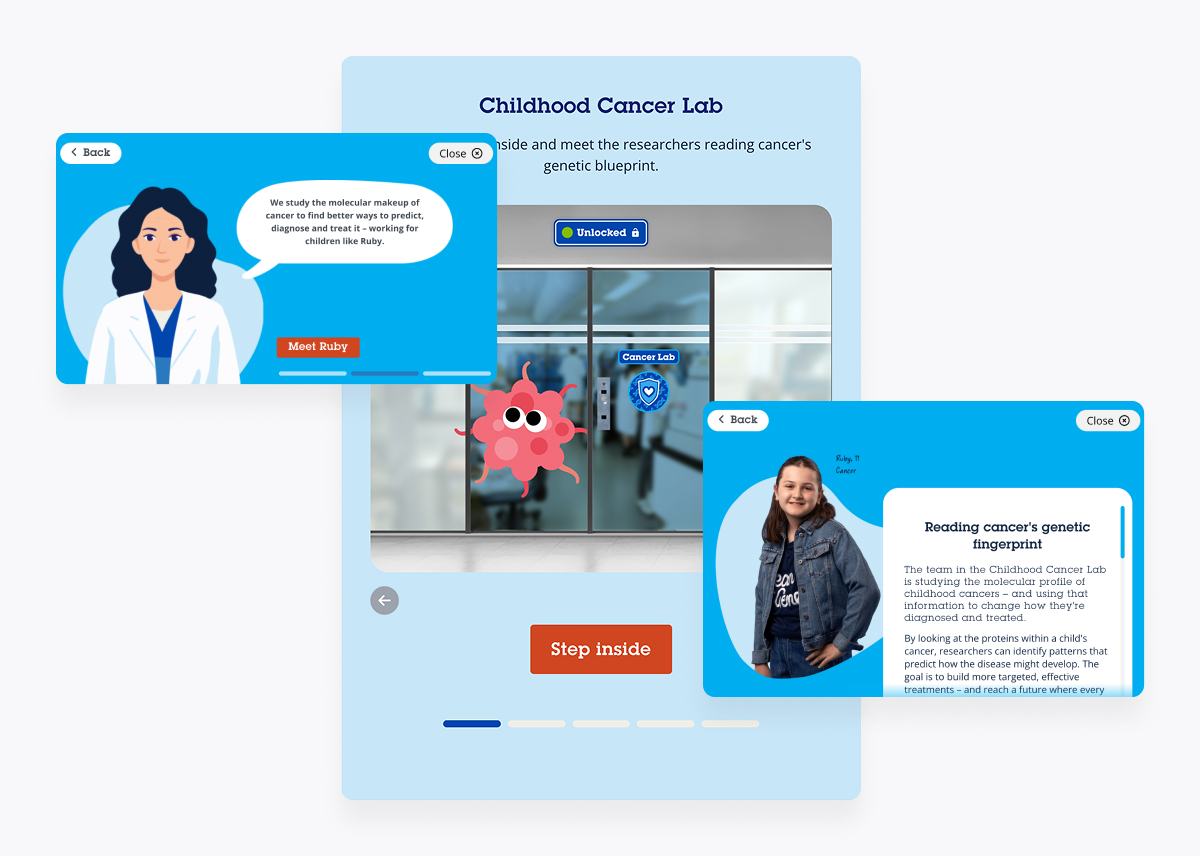
New this year, five behaviorally-triggered "lab doors" — unlocked by registering, hitting 10 donations, or reaching VIP status — each open onto one of CMRI's real research labs and a child whose condition is connected to that area of research. The experience was a first of its kind built on Funraisin, with Greg describing the thinking behind it: "The aim was to connect fundraisers more closely to the cause, so they could see the research their fundraising is helping make possible and understand why their support is so important."
A full week of warm-up before the match funding clock starts.
Rather than staying quiet before Double Donation Day and risking donor fatigue, CMRI runs a deliberate warm-up from the Monday of match-funding week: an announcement bar on the site, then emails and SMS building anticipation through Wednesday, so that by the time Double Donation Day opens at 8am Thursday, the entire audience already knows it's happening.
The experience: A unique journey for both returning and first-time givers
For a first-time donor, the general Double Donation Day page opens to a live, custom-built progress bar climbing in real time, pulling in donations from every fundraising and donation page across the campaign as they happen.
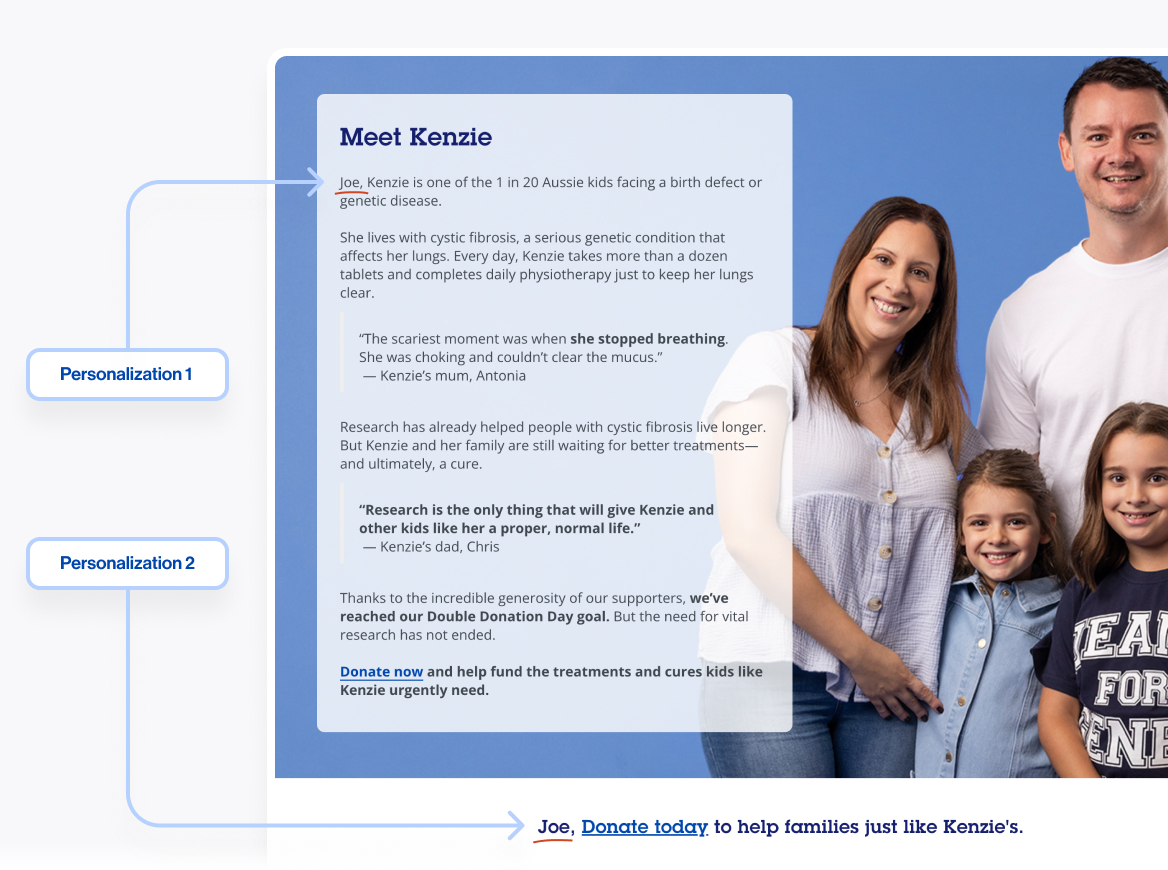
For a returning donor redirected to the personalized Double Donation Day page, the page already knows their name and their history — the suggested amounts reflect what they gave last time, and the copy reminds them of the impact of their previous support.
Either way, donations made through both donation pages and all fundraising pages feed into the same collective Double Donation Day total, keeping the focus on the shared campaign result rather than any one individual transaction.
Double Donation Day: $800k unlocked before the first day was over
By 2:30pm on the first day of Double Donation Day, over $800k in donations had already come in, matched dollar-for-dollar to $1.6 million—a campaign record before the day was even over.
That speed gave the team the confidence to commit their final, largest round of matching, pushing toward a bold $2M+ target. They landed at $2.24M+, 52% ahead of the previous year's record.
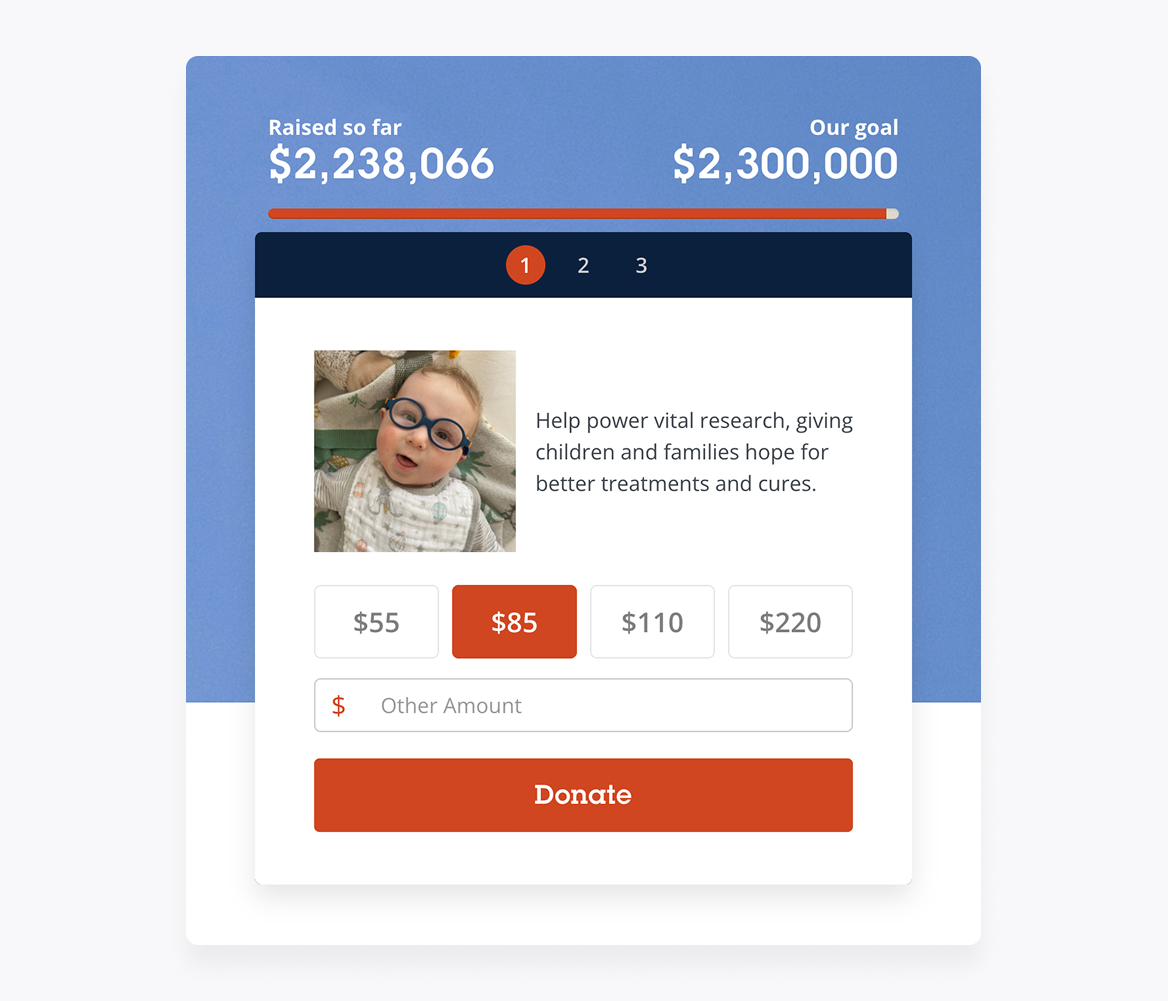
My biggest fear every Double Donation Day is that the custom progress bar won’t work and donations from across all our fundraising and donation pages won’t pull through properly. Fortunately, it worked like clockwork again.
Greg Noel-Butterworth,
National Campaign Manager, Jeans for Genes
The results: a full-year record, broken with two events still running and donations continuing through to the end of the year

$3.7M+
Total raised over $600k above the previous best full year

35%
Completed registrations grew year-on-year

45%
Active fundraisers grew year-on-year
- Raised more than $600k above its previous best full year, with the total climbing to upwards of $3.7 million by mid-August
- Two fundraising events still running, with donations continuing to come in through to the end of the year
- Completed registrations grew 35% year-on-year
- Active fundraisers grew 45% year-on-year
- Double Donation Day alone brought in $2.2M+, up 52% on its previous record
What you can apply

Test new event formats small before committing.
100 Skips a Day proved itself as a $300k Facebook fundraiser and a $420k mini peer-to-peer before CMRI invested in building it into a full peer-to-peer event.

Build the audience and the match fund at the same time.
A large matched-giving pool means little without a warmed-up, educated donor base ready to act on the day.

Don't stay silent before a big campaign moment.
A deliberate pre-launch build-up outperforms a single-day announcement.

Reward early habits, not just final outcomes.
The three-day streak mechanic targeted the exact point where fundraisers are most likely to drop off.

Segment your donation pages by donor history, not just by channel.
A returning donor and a first-time donor are asking different questions — give them different pages.

Tie every dollar back to something specific and real.
The lab tour worked because it replaced a general impact statement with an actual person and an actual lab.

Measure activation rate alongside revenue, not just revenue alone.
It helps show whether growth is coming from more people or more value per person.
There’s rarely been a time when we’ve brought an idea to Funraisin and been told it can’t be done. That gives us the confidence to keep being ambitious and trying new things. Often, the only limit is what we can imagine.
Greg Noel-Butterworth,
National Campaign Manager, Jeans for Genes
Thinking about what a matched-giving day could do for your campaign?
Let's talk about it.

